Contents
Google now rewards authenticity signals that AI can't replicate: original research, named human expertise, specific examples from real projects, and verifiable credentials. Auditing your existing post for these and embedding the missing ones will lift its ranking faster than publishing ten new posts, because it proves a real expert wrote what you already have.
The good post that keeps losing
You wrote a good post. You know you did.
Real advice. Stuff you learned the hard way. And it's sitting on page three while some AI-spun word smoothie about the exact same topic parks itself at the top of the results.
Infuriating, right?
Here's the thing though... that losing post is the most useful thing you own right now. Because it shows you the exact gap. It's not that your content is bad. It's that Google can't tell a human wrote it.
Think of the competitor's AI post like a parrot that's memorised the Hippocratic oath. Says all the right words. Sounds like a doctor. But it can't actually prescribe you anything, and Google is slowly learning to notice the difference.
The flood changed the math. When AI could suddenly produce infinite passable posts, "passable" stopped being worth anything. So the search engine started leaning harder on the signals a machine can't fake: proof that a real person, with real scars, actually did the thing.
Seth Godin puts it plainly in his book This is Marketing. Persistent, consistent, and frequent stories, delivered to an aligned audience, will earn attention, trust, and action. Attention. Trust. Action. Those are the same things Google is trying to measure on your behalf.
Your post has the story. It just forgot to prove it was yours.
Let's fix that. One signal at a time.
What Google actually sees when it grades you
You optimized for keywords. You nailed the headings. You hit the word count. And you still lost.
That's because Google stopped grading the essay and started grading the author.
This is the whole idea behind E-E-A-T: experience, expertise, authoritativeness, trust. The system is trying to answer one question about your post. Did a real human who has actually done this write it? Or did something just recite the words?
Brené Brown, in her book Daring Greatly, has a line that basically nails Google's new grading rubric. What we know matters but who we are matters more. Your post is loaded with what you know. But it's shy about who you are. And "who you are" is precisely the part a parrot can't fake.
The signals your post never thought to send are the ones now doing the ranking.
Here's what that looks like in practice. Four markers Google leans on:
- Original research. A number you generated, not one you borrowed from page one.
- Named expertise. A human byline with credentials, not "Team Content."
- Specific real examples. The project, the client, the mess, the fix.
- Verifiable credentials. Proof you can actually prescribe, not just recite.
Your good post probably has zero of these switched on. Not because you're a fraud... you just wrote the advice and forgot to sign it in blood.
Every one of these is auditable. You can literally scan a post and count how many are missing. That's the good news, you know. Vague problems are miserable. Countable ones you can fix by Friday.

The live fix, one signal at a time
Okay. Open the losing post. We're going to switch the signals on, one by one, in about ten minutes each.
Signal one: original research. Find the sentence where you cited someone else's stat. Now ask what number you could report instead. "We ran this on twelve client accounts and month two was the turn." Boom. Information gain. You just gave the searcher something that exists nowhere else.
Signal two: named expertise. Kill the anonymous byline. Put a human name on it, with a line about why that human is allowed to have opinions here. The parrot has no name. You do.
Signal three: the real example. Somewhere you wrote a tidy abstract claim like "personalization improves engagement." Replace it with the actual moment it happened to you. The client, the campaign, the thing that broke at 2am.
Signal four: verifiable credentials. Link out. To your case study, your data, your ugly spreadsheet. Give Google somewhere to go to confirm you're not just reciting the oath.
When I audit a post against these four, the fastest lift I see comes from swapping one borrowed stat for one number the writer actually generated. That single move, original research over recited research, tends to do more than a full rewrite.
Godin again, from This is Marketing. Marketing is the generous act of helping others become who they seek to become. It involves creating honest stories, stories that resonate and spread. Honest stories. Every signal above is just you being honest about who did the work.
Each marker has one thing you can spot in a scan. So don't rewrite. Audit, then patch the holes.

The after version doesn't just feel better
Now read the two versions side by side.
Before: competent, keyword-tidy, and completely anonymous. It could've come from anyone or anything. After: it's got a name, a number nobody else has, a real project, and a link that backs it up.
The difference is visible. Not a vibe. You can point at the exact sentences that changed.
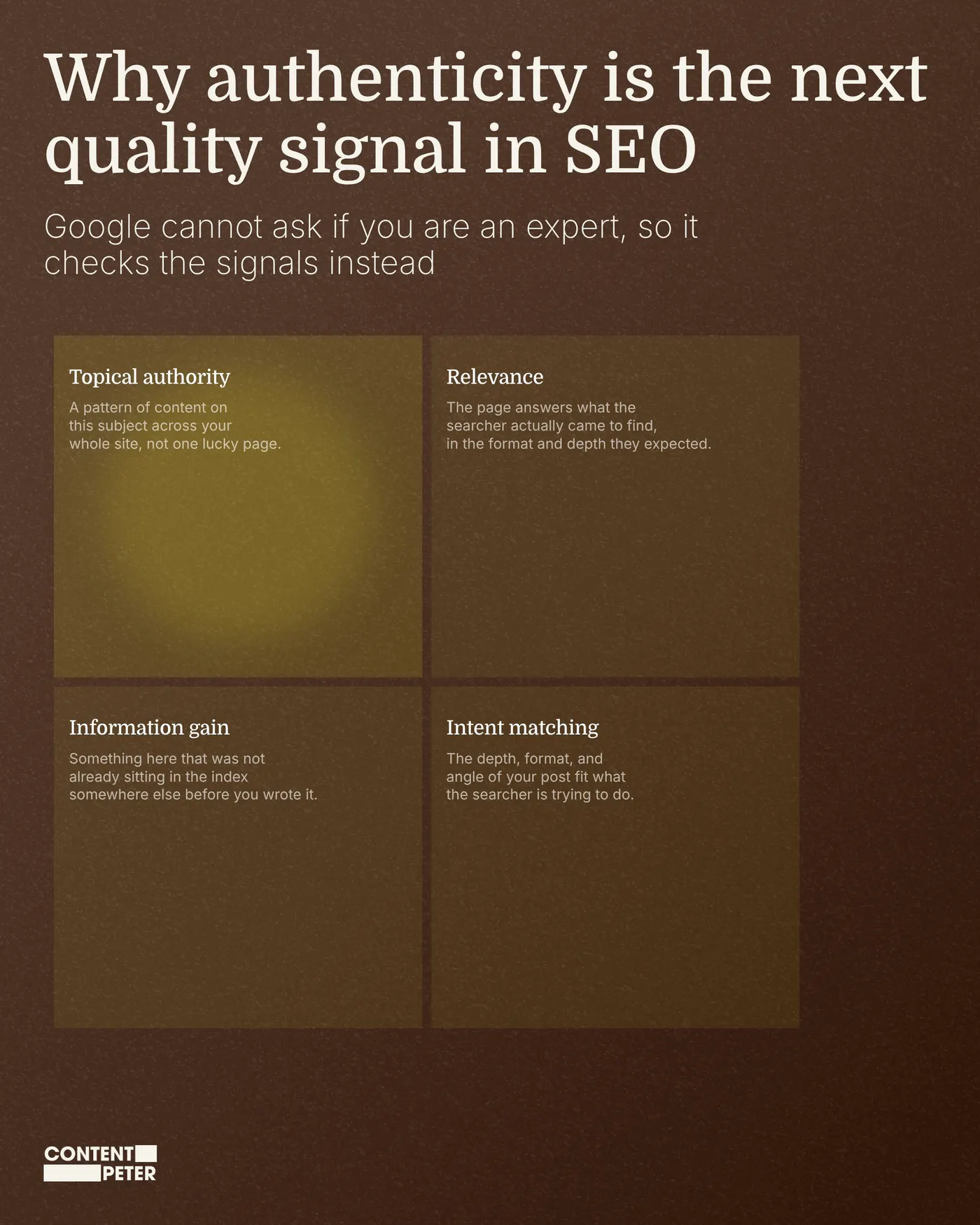
And here's why that translates into rankings instead of just feelings. Petar Petrović framed it well on his LinkedIn: positive user signals are hard to fake because they're made up of topical authority, relevance, information gain, and matching intent. This, he says, is why black hat tactics have a short shelf life. They try to game the system without giving back to the searcher.
Your patched post gives back to the searcher. The original stat is information gain. The real example is intent matching. The named expert is authority. You didn't game anything. You just made the human visible.
The AI competitor can't follow you here. It can add more words. It can spin ten variations. But it can't manufacture the twelve accounts you ran, or the client who fired you, or the number you earned. The parrot can add verses to the oath all day and still can't write a prescription.
That's the moat. Not that you write better sentences. That you have a past, and now the post admits it.
Now run it on everything you own
Here's the part I love.
You have a folder full of these. Posts that were good and quietly lost. Every one of them is the same ten-minute job you just did.
Pull the four-signal audit up before anything ships. Original research on? Named human on? Real example in? Credential linked? Four boxes. If one's empty, you know exactly what to add, and you know it beats writing a whole new post that'll just lose the same way.
Run it every time. And the gap between you and the slop widens with each publish, because they're stacking words while you're stacking proof.
Don't overthink the moat metaphor either. It's like a dog and its scent. A hundred dogs can bark the same bark. Only one leaves a trail that leads back to a real animal that was actually there. Google's just learning to follow the trail.
So stop grinding out post number eleven.
Go fix post number one instead. The insight was always real. The experience was always yours. The examples actually happened.
You already did the hard part. Google just could not tell yet.
Key takeaways
- Fix before you write. Patching the authenticity signals in your worst existing post will outrank publishing ten new ones.
- Google grades the author, not just the essay. E-E-A-T means it's looking for proof a real, experienced human wrote what you published.
- Four auditable signals do the lifting: original research, named expertise, specific real examples, and verifiable credentials. Each is spottable in a ten-minute scan.
- These signals are the moat. AI can add words but can't manufacture your projects, numbers, or scars, which is why, as Petar Petrović notes, black-hat shortcuts have a short shelf life.
- Make it a shipping ritual. Run the four-box audit before every post and the gap between your work and the AI flood widens each time.
Questions readers ask
How does Google measure and reward authentic expertise through E-E-A-T?
E-E-A-T stands for experience, expertise, authoritativeness, and trust. Google leans on signals that suggest a real, qualified human did the work: original research, named authors with credentials, specific examples from real projects, and links that verify your claims. These are hard for AI to fake, so they've become a reliable proxy for authenticity.
What are Google's guidelines for expertise in content ranking?
The practical read is that Google now grades the author as much as the article. As Brené Brown's line in Daring Greatly captures, who you are matters more than what you know. Signal your identity clearly: a real byline, credentials, first-hand experience, and evidence a searcher can check. That's what separates a genuine expert from a post that only recites the right words.
What is Google's perspective on AI-generated content and ranking?
The problem isn't AI itself, it's that AI floods search with passable-but-anonymous content, so "passable" stopped being worth ranking. Google responded by rewarding the human signals AI can't replicate. Petar Petrović notes that positive user signals, built from topical authority, relevance, information gain, and matching intent, are hard to fake, which is why shortcut tactics have a short shelf life.
See one idea on every channel
The LinkedIn post, the X thread, the carousel and the newsletter, from the same idea.

Content creator, marketer, educator and entrepreneur. Passionate about creating content that is human, enduring, empowering.
LinkedIn