Contents
Use AI for production tasks like drafting, formatting, and adapting one idea across channels. Keep strategy, research validation, positioning, and the trust-building insight for yourself. AI only speeds you up once you stop asking it to think. The rewriting isn't a copy problem, it's a bad division of labor between you and the machine.
The costly before you already know too well
You know the drill.
You open the AI tool. You type "write me a blog post about our new feature." You hit go.
And out comes... something.
It has paragraphs. It has headings. It sounds confident. It also sounds like every other post on the internet, written by a very polite intern who has never met a single one of your buyers.
So you spend the next two days fixing it. Then reformatting it for LinkedIn. Then again for the newsletter. Then again for X.
By Thursday you've published five things that all read like the same beige blog post wearing different hats.
Here's the thing though. AI clearly works when it's pointed right. one B2B software vendor using Uberflip's platform saw a 70 percent rise in leads over three months, crediting better personalization and automation. And according to the 2026 state of marketing report, 80% of marketers use AI to create content and 75% use it to produce media.
So the tool isn't broken. Your setup is.
The problem was never AI's output quality. The problem is task assignment. You handed the machine the one job it can't do (think like your buyer) and kept the ten jobs it does brilliantly (format, structure, repeat) for yourself.
That's backwards. Let's flip it.
Why AI breaks down the second you ask it to think
Let me explain what's actually happening inside that box.
An AI model isn't researching. It isn't reasoning about your market. It's predicting the likeliest next word, then the next, based on patterns it swallowed during training.
Which is great for grammar. Terrible for originality.
Think of it like a parrot who's read the entire internet. It can repeat anything convincingly. It just has no idea what any of it means, and it has definitely never had coffee with your ideal customer.
And yet, when you aim it well, the money follows. McKinsey's research on AI adoption found two out of every three companies using AI for marketing content noticed significant revenue increases in the first 12 months.
So why is everyone still drowning in rewrites?
Because knowing AI is powerful and actually using it well are two very different sports.
The State of AI in B2B Marketing Report by The Growth Syndicate nailed the gap. Teams rate AI's potential benefits at 8.8 out of 10. They rate their actual execution at 6.4. Only 26 percent rate their execution at 8 or higher.
Read that again.
Almost everyone believes. Almost nobody executes.
That gap? That's the sound of thousands of marketers asking a next-word-prediction machine to have an original strategic insight... and then acting surprised when it hands back oatmeal.
The fix isn't a better prompt. It's giving the machine a job it can actually do.
The right split between you and the machine
Here's the whole formula, and it's simpler than the tool vendors want you to believe.
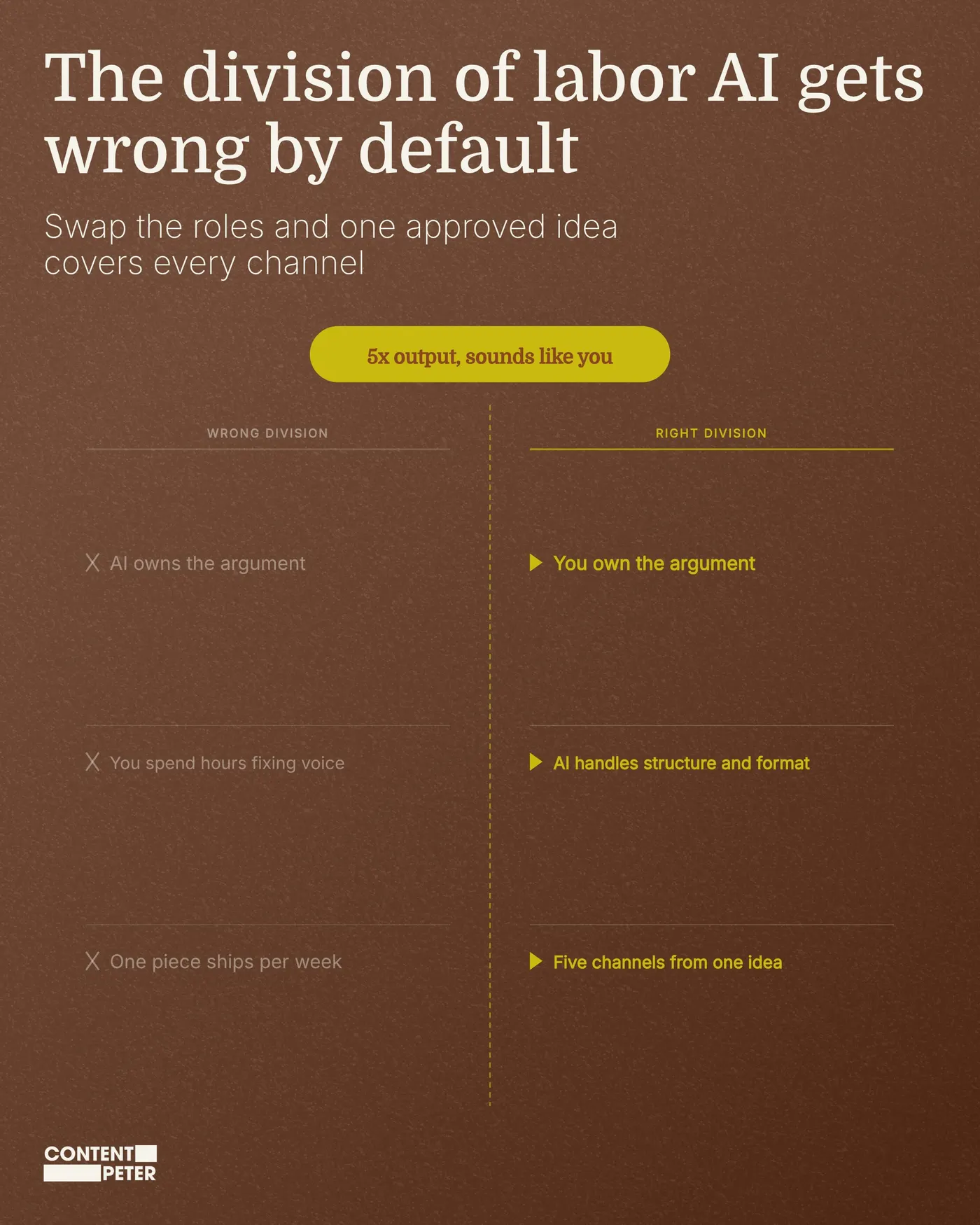
AI owns structure. You own the argument.
The machine drafts, formats, adapts, and builds the QA skeleton. You bring the strategy, the research validation, the competitive positioning, and the insight that makes a buyer actually trust you.
Four things stay yours. Always.
Strategy. What are we saying, to whom, and why now. A word-predictor can't decide your point of view.
Research validation. AI will state a "fact" with total confidence and zero source. You're the one who checks whether it's real.
Positioning. Why you beat the other guy. That lives in your head and your sales calls, not in a training dataset.
The insight. The one line that makes a reader stop and go "huh, they get it." That's the whole game.
I've watched teams treat AI like a writer and then wonder why the copy has no spine. The ones who win treat it like a very fast assistant with no opinions. They keep the four judgment calls above and hand off everything else. Their rewrite time drops off a cliff, because they stopped correcting a machine for failing at a job it was never built for.
And the demand for real insight is spiking. Your buyers are doing more research than ever. They can smell filler from three tabs away.
As Dr. Mike Horton put it on LinkedIn, the tool is a multiplier, not a replacement. AI enhances. It doesn't invent your point of view.
Get the split right and the whole thing stops fighting you.
The cleaner after, where one idea becomes five
So what does the good version look like on a normal Tuesday?
You approve one idea. Just one. The strategy, the angle, the proof, all decided by you in about twenty minutes.
Then the machine goes to work. The blog article. The LinkedIn post. The X thread. The newsletter... all of it.
Each one shaped for its own channel. Each one carrying your insight, not a generic rewrite of the same paragraph five times.
This is the part that used to eat your Wednesday and Thursday. Now it's the boring part, and boring is exactly what you want AI doing.
You're in good company here. the G2 Spring 2026 Report found over 80% of marketers use AI for content creation, including email copy, in 2026, a real shift from manual production to AI-assisted creation at scale.
But scale without a point of view is just louder noise.
Which is why the human input at the top matters so much. Gary Vaynerchuk, in his book Jab, Jab, Jab, Right Hook, put it as clean as anyone: content is king, but context is God.
The AI produces the content. You supply the context. The reason this piece exists, who it's for, what makes it true for your buyer and nobody else's.
Strip out the context and you've got five channel-ready pieces of nothing.
Keep it, and one approved idea walks out the door as five things that all sound like you had time to write them by hand.
You didn't. That's the point.
The one test that tells you if AI did its job
Here's the check. It takes about ten seconds.
Look at what came back. Are you rewriting sentences? Fixing word choice, smoothing phrasing, arguing with the copy line by line?
Then AI is doing the wrong job. Full stop.
Remember what's under the hood. Altitude Marketing explains it plainly: the model learned patterns of which words follow others, and when you prompt it, it's predicting the most likely next word based on training. It excels at structure and grammar. It struggles with originality.
So if you're rewriting for insight, you asked it to be original. That's on the setup, not the tool.
Think of AI as a photocopier. It reproduces your best idea and your worst one with the exact same enthusiasm. Feed it a sharp, well-researched angle and it duplicates brilliance all day. Feed it "write something about our product" and it happily copies your vagueness onto five channels.
The photocopier isn't the problem. The original you fed it is.
Good AI, pointed right, only asks you to check facts and sharpen the one human line that lands. Everything else it hands back clean.
And when it's clean, you notice something else. Vaynerchuk, again in Jab, Jab, Jab, Right Hook, warns that information is cheap and plentiful, but information wrapped in a story is special, and brands need to storytell around content, not serve it up like a boring platter of cubed cheese.
The story is your job. Forever.
The formatting, the reformatting, the five-channel grind? Good AI does the boring parts so well you forget it's there. You stop noticing the machine, and you go back to doing the one thing only you can do.
Key takeaways
- The rewrite problem is a labor problem. You're not fixing bad copy, you're correcting AI for a thinking job it was never built to do.
- AI predicts the next word, it doesn't reason. That's why it wins on structure and grammar and loses on original insight, per Altitude Marketing.
- Four things stay human: strategy, research validation, positioning, and the trust-building insight. Hand off drafting, formatting, and multi-channel adaptation.
- One approved idea should become five channel-ready pieces that each sound like you, because you supplied the context and AI supplied the reps.
- The ten-second test: if you're rewriting sentences for insight, AI is doing the wrong job. Point it at a sharp original and it copies brilliance, not filler.
Questions readers ask
What's the right AI and human collaboration workflow for B2B content in 2026?
You approve one idea, including the strategy, positioning, and proof, then AI drafts and adapts it across your blog, LinkedIn, X, newsletter, and YouTube. You keep the four judgment calls: strategy, research validation, positioning, and insight. AI handles drafting, formatting, and multi-channel adaptation. That split is what turns one idea into five channel-ready pieces without eating your week.
How do I evaluate whether AI-generated content is good or just needs rewriting?
Run the ten-second test. If you're rewriting sentences for insight or originality, AI was pointed at the wrong job, because as Altitude Marketing explains, it predicts likely words rather than reasoning. Good output should only need fact-checking and one sharpened human line. If you're arguing with the copy line by line, fix the input, not the sentences.
When is rewriting AI content more expensive than just writing it yourself?
The moment you're rewriting for strategy, positioning, or insight. That's the exact point AI stops saving time and starts costing it, because you're correcting a machine for failing at a thinking task. Keep those four jobs human from the start and AI only ever adds speed. The State of AI in B2B Marketing Report shows most teams rate execution at just 6.4 out of 10, and this misassignment is why.
Does using AI mean diluting my brand voice?
Only if you ask AI to invent the voice. Gary Vaynerchuk's line holds: content is king, but context is God. You supply the context, the point of view and the story, and AI reproduces it across channels. Feed it a sharp original and it copies your voice faithfully, like a photocopier duplicating your best idea.
See one idea on every channel
The LinkedIn post, the X thread, the carousel and the newsletter, from the same idea.

Content creator, marketer, educator and entrepreneur. Passionate about creating content that is human, enduring, empowering.
LinkedIn